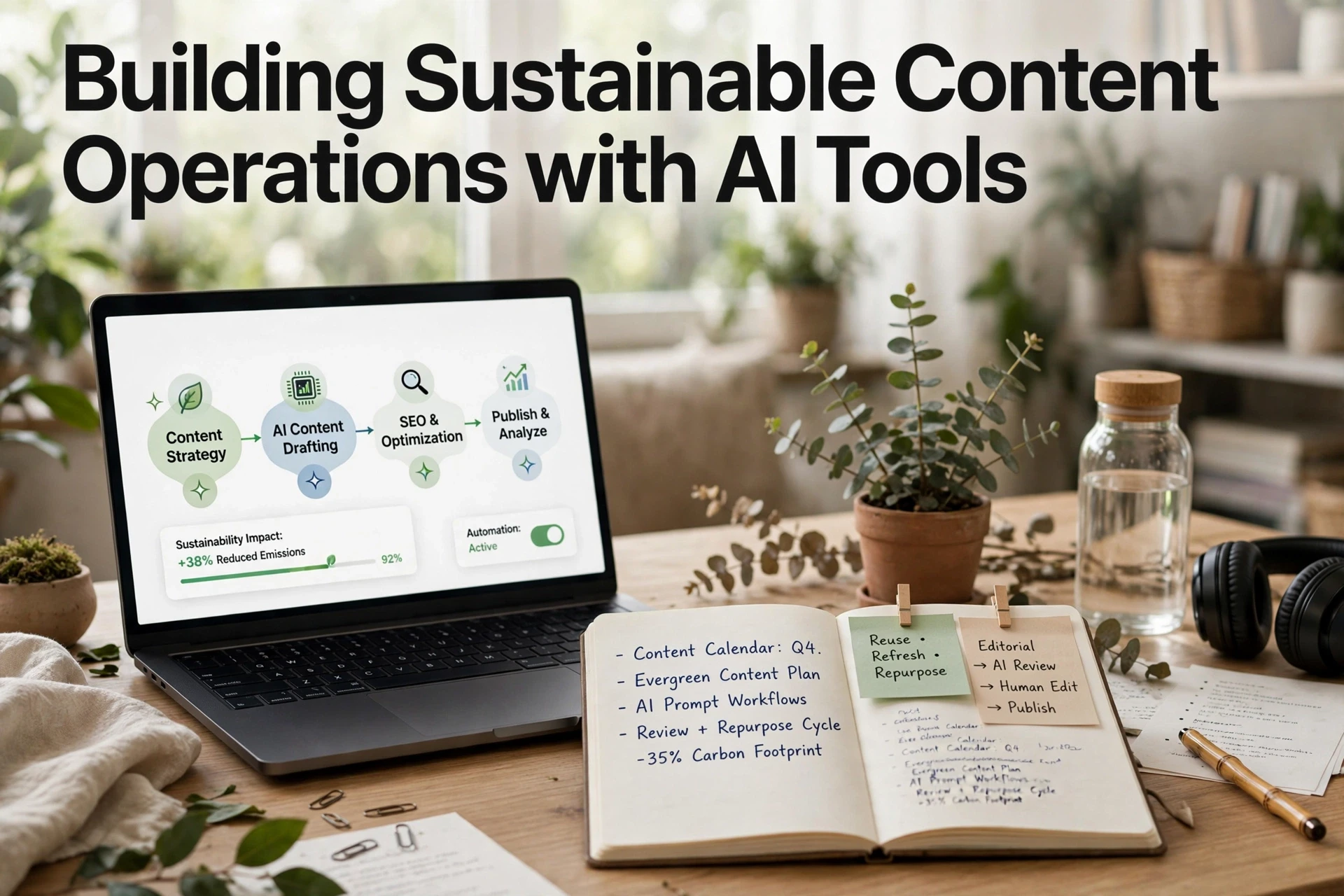
Quick Summary: Sustainable AI content operations start with governance, then break work into standardized briefs, constrained drafting, human verification, and publication, with each stage assigned an owner and measurable quality gate. Teams should track cycle time, revision rounds, acceptance rates, rework hours, rankings, and AI citations, then feed those findings into future briefs and refreshes. SnowSEO supports this loop by combining audits, keyword research, governed AI content, rank tracking, and generative engine reporting.
AI-driven content operations is a governed workflow where AI handles drafting, optimising and tracking tasks, while your team owns strategy, editorial checks and quality gates at each stage. In 2026 research across 500 marketing leaders, tooling was no longer the constraint. Teams had AI, but no repeatable workflow, so output scaled while quality, governance and visibility stayed flat. This guide fixes that: it maps each pipeline stage to a measurable gate, from brief to AI visibility tracking, so AI adds execution capacity without replacing strategy.
Table of Contents
Step 1: Define Governance and Quality Gates Before Generating
Most teams buy tools first and write rules later. That order fails. AI-driven content operations needs editorial governance agreed before the first prompt: who owns briefs, who approves drafts, and which tools touch which AI content workflow stages.

Setting the Roles, Process and Tool Boundaries
Name three roles at minimum: the strategist who owns briefs, the editor who approves drafts, and the person accountable for publishing. Then set tool boundaries. Decide what AI may draft, what it may never decide (angles, claims, positioning), and where humans must sign off. Platforms such as SnowSEO fit inside these boundaries; they do not replace them.
Defining a Standard That Is Actually Testable
A quality gate fails if "good" stays vague. For AI-assisted drafts, a gate should include:
- A factual check against a named source
- An original angle, not a competitor rehash
- The brief's target keyword and search intent met
- Brand voice and claims rules followed
- A named approver and date
If a checker cannot verify each item in minutes, sharpen it. Vague gates let weak drafts through.
Step 2: Build the Pipeline as a Sequence of Bounded Stages
To build a sustainable content pipeline using modern AI tools, split the work into bounded stages, each with its own owner and quality gate:
- Research and brief standardisation
- AI-assisted drafting with constrained scope
- Verification, enrichment and publication
Each stage ends with a check before work moves on, so errors never travel downstream.

Research and Brief Standardisation
Fix the brief format once: target keyword, audience, angle, word count and sources. Writers and AI models then start from the same inputs, which removes guesswork. Many teams run this stage inside an AI-driven content operations platform, where keyword research and brief templates sit in one place.
AI-Assisted Drafting With Constrained Scope
Give the model the approved brief, not open-ended prompts. Limit it to the section structure and facts you provide. This keeps claims traceable and prevents invented details. Draft outside the brief? Reject it at the gate rather than editing a bad base.
Verification, Enrichment and Publication
A human checks every claim, number and link before publication. Add internal links, original data or expert quotes that AI cannot supply. Only then does the piece ship, with metadata and tracking in place.
Step 3: Measure, Review and Rebuild the Loop
Operational Metrics for the Pipeline Itself
Track the workflow itself, not only the output. Watch cycle time per brief, revision rounds, first-pass acceptance rate and rework hours. Set thresholds: if drafts need more than two rounds, the briefs need work. These numbers show whether the pipeline is improving or quietly breaking.
Closing the Loop with Ranking and AI Visibility Data
Metric | What it tells you | Gate |
|---|---|---|
Rank movement | Query coverage | Revisit the brief if flat |
AI citations | Answer engine visibility | Refresh thin pages |
Traffic decay | Content decay | Schedule a rebuild |
Review each page on a set cadence, monthly for priority topics and quarterly for the rest. AI visibility tracking closes the gap search rankings alone leave, because AI answers cite or skip your pages for reasons rankings never show. SnowSEO pairs rank tracking with generative engine reporting in one dashboard, so one review covers both. Feed every rebuild decision back into the briefs, and the loop restarts stronger.
Common Mistakes to Avoid
Failure Patterns and Their Corrections
Most AI content programmes fail the same few ways. Publishing without a brief makes drafts drift off strategy, so standardise briefs before you scale output. Skipping human review ships factual errors, so make an editor a fixed quality gate. Generating near-duplicate pages causes cannibalisation; map keywords to one owner page each. Ignoring content decay lets rankings slide quietly, which is why regular content audits matter. And treating AI visibility as a launch metric, not a tracked one, hides whether answer engines actually cite you. Fix these five and the rest of the pipeline holds.

Ready to build a content operation that scales without losing quality? SnowSEO gives you audits, keyword research and governed AI content in one place. Start free today.
Frequently Asked Questions
Q1: How can teams build a sustainable content pipeline using modern AI tools?
Split work into bounded stages: standardised briefs, constrained AI drafting, then human verification. Give each stage a named owner and a quality gate, and feed rank and AI visibility data back into briefs.
Q2: How many revision rounds should AI-assisted drafts need?
One to two. If drafts consistently need more, fix the brief, not the editing process.
Q3: How often should published content be reviewed?
Monthly for priority topics, quarterly for the rest. Watch traffic decay and refresh thin pages before rankings slip.
Q4: What metrics prove the pipeline itself is healthy?
Track cycle time per brief, revision rounds, first-pass acceptance rate and rework hours. Rising rework signals upstream problems, usually weak briefs or missing governance.
Conclusion
Sustainable content operations come from governance first, bounded pipeline stages second, and measured loops third. AI expands execution capacity; your team still owns strategy, quality gates and refresh decisions. Build that system, and output scales without quality slipping.