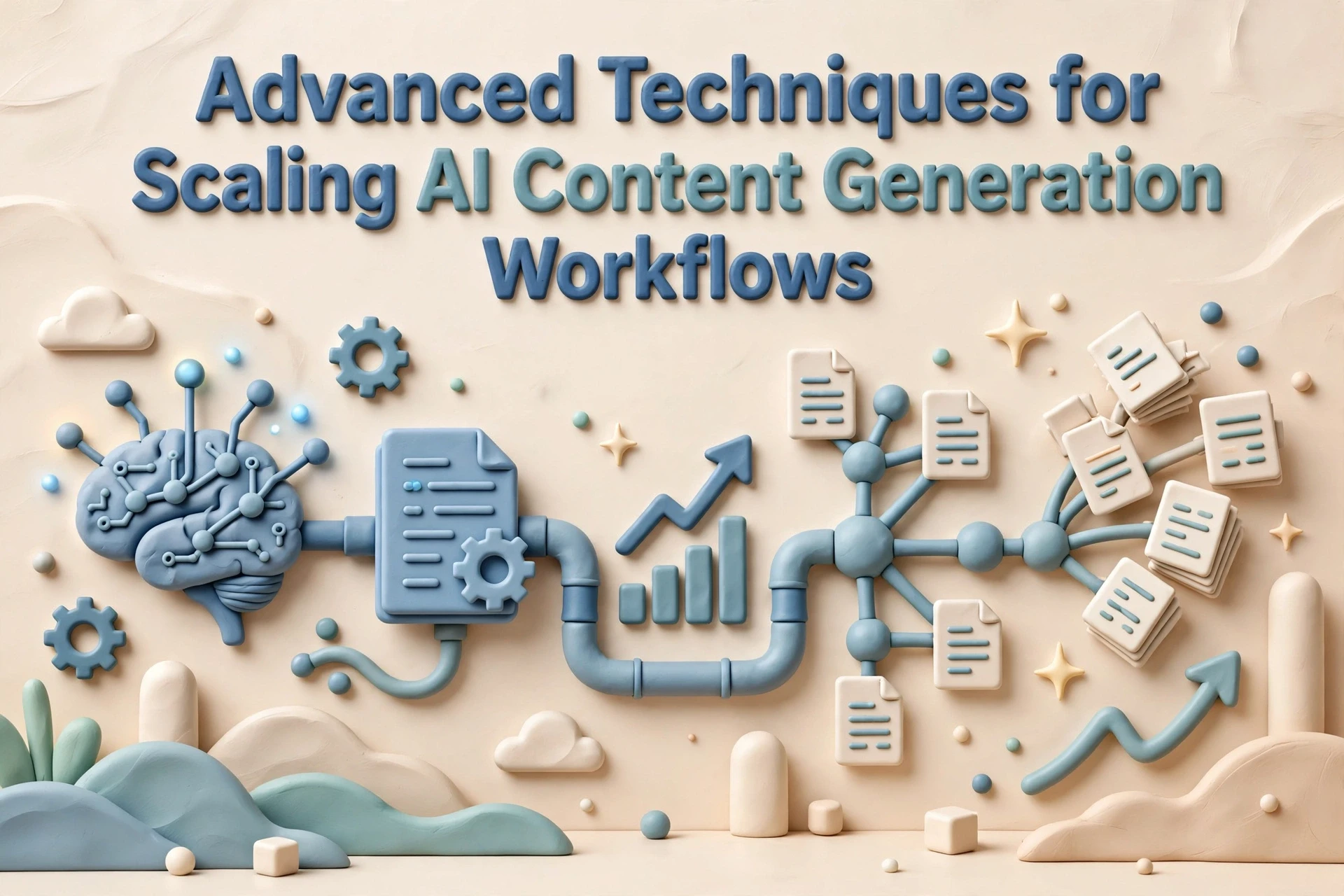
Quick Summary: Scaling AI content requires a five-stage pipeline with stage-specific prompts, automated SEO and AI visibility checks, and risk-based editorial review. Turn recurring edits into template rules, reduce review for proven templates, and measure rankings, organic sessions, and AI citations alongside production volume and QA pass rates. Platforms such as SnowSEO can support these handoffs by combining audits, keyword research, quality checks, and AI visibility tracking.
Two agencies added an AI writer last quarter. One shipped 300 posts and watched rankings flatten. The other shipped 90 and doubled organic sessions. The difference was not the model; it was what happened between the brief and the publish button. This guide covers scaling AI content workflows: quality gates, tiered review, and AI search visibility checks that turn drafts into results.
Table of Contents
Step 1: Build a Modular Pipeline Instead of One-Prompt Drafts
One prompt cannot handle research, drafting, and editing well. To start scaling AI content workflows, split production into five repeatable stages:
- Keyword and intent research
- Outline and brief generation
- AI-assisted drafting
- Tiered editorial review
- Optimization and publishing
Each stage feeds the next, so a weakness in research never silently corrupts the finished draft.

Then write a prompt template per stage, not per article. A draft prompt that assumes a strong brief stays short and reliable. Fix a bad output at the stage that caused it, and the fix applies to every future piece.
This structure fixes quality drift fast. Editors spot errors earlier, throughput becomes predictable, and you can measure which stage bottlenecks output. Tools built around an integrated AI content production pipeline, such as SnowSEO, make these handoffs easier to manage.
Step 2: Put Automated SEO and AI-Visibility Checks in the Pipeline

What to check before a human ever sees the draft
Run every draft through automated content QA first. Filter for keyword intent match, duplicate passages, thin sections and content cannibalization against existing pages. AI content quality gates catch these mechanically, so editors spend time on judgment calls, not spelling. A single dashboard that combines these checks and AI search visibility tracking saves hours per week, which is how platforms like SnowSEO fit into daily content operations.
How do you scale AI content production without losing quality?
Four levers hold quality steady as output grows:
- Tiered review: short updates get one editor pass, money pages get two.
- Quality gates: block publishing on any failed automated check.
- Human in the loop review for claims, quotes and examples.
- Throughput vs outcome metrics: measure rankings and leads, not posts shipped.
Skip any lever and volume quietly erodes trust in the whole pipeline.
Check readiness for AI answers, not just blue links
Classic rank checks miss ChatGPT and Claude citations. Add generative engine optimization checks: does the draft answer likely prompts, cite-able facts and clear entity signals? Pages built this way surface in AI answers, and platforms tracking AI citations, from Otterly AI to SnowSEO, make that shift measurable.
Step 3: Build a Review Loop That Gets Lighter, Not Heavier
Tier the review by risk and template age
How do you do sampled quality review for AI content at scale? Check a random sample of each template's output weekly, and read every draft in high-risk categories like money pages and YMYL topics line by line. New templates get full review; proven ones get spot checks. Track edits per draft, and cut review depth only when that number drops.
Turn brand voice into constraints, not vibes
Vague style notes force editors to rewrite everything. Instead, convert voice rules into checkable constraints: banned phrases, required structure, claim limits. Then much of the review becomes automated content QA, and editors judge argument and accuracy rather than tone. Teams that structure checks this way review faster, as this AI content review workflow guide describes.
Close the loop with production data
Feed reviewer edits back into prompts weekly. Every recurring fix becomes a template rule, so the same mistake stops reaching review. Measure throughput against outcomes: ranked pages and AI search visibility tracking, not drafts shipped. A good loop shrinks while quality holds.
Step 4: Measure Output and Outcomes Separately
Count production and results in two columns, or you will optimize the wrong number.
Track throughput and outcome as two separate sets of numbers
Metric | What It Proves |
|---|---|
Drafts shipped per week | Pipeline speed and capacity |
Pieces passing QA first pass | Draft quality |
Pages indexed | Publishing actually lands |
Organic sessions and AI search citations | Content earns traffic and visibility |
Track AI search visibility alongside rankings, since AI platforms cite sources Google may not.
A 30-day order of operations
Run week one with no changes: record baseline drafts, QA pass rates and sessions. Week two, fix the worst QA failure mode only. Week three, adjust briefs for the weakest intent match. Week four, review whether outcomes moved with rank tracking.

Scaling a content pipeline only pays off when every draft ranks and gets cited. SnowSEO combines audits, keyword research, and AI visibility checks in one platform, so start your free trial today.
Frequently Asked Questions
Q1: What advanced techniques scale AI content production without losing quality?
Use a five-stage pipeline, automated quality gates, tiered editorial review, and outcome metrics. Block publishing on failed checks, and sample-review proven templates weekly.
Q2: How often should I feed editor edits back into AI prompts?
Weekly. Convert recurring fixes into template rules so repeated mistakes stop reaching review.
Q3: How do I make content show up in ChatGPT and Claude answers?
Add generative engine optimization checks: answer likely prompts, include citable facts, and strengthen entity signals.
Q4: Which metrics prove an AI content pipeline actually works?
Track both columns: drafts shipped and first-pass QA rate for speed, plus indexed pages, organic sessions, and AI citations for outcomes.
Conclusion
Scaling AI content generation workflows succeeds when you treat production as a pipeline: stage-specific prompts, automated quality gates, tiered editorial review, and metrics that pair throughput with outcomes like rankings and AI citations.